

Sadness
A Brief Exploration

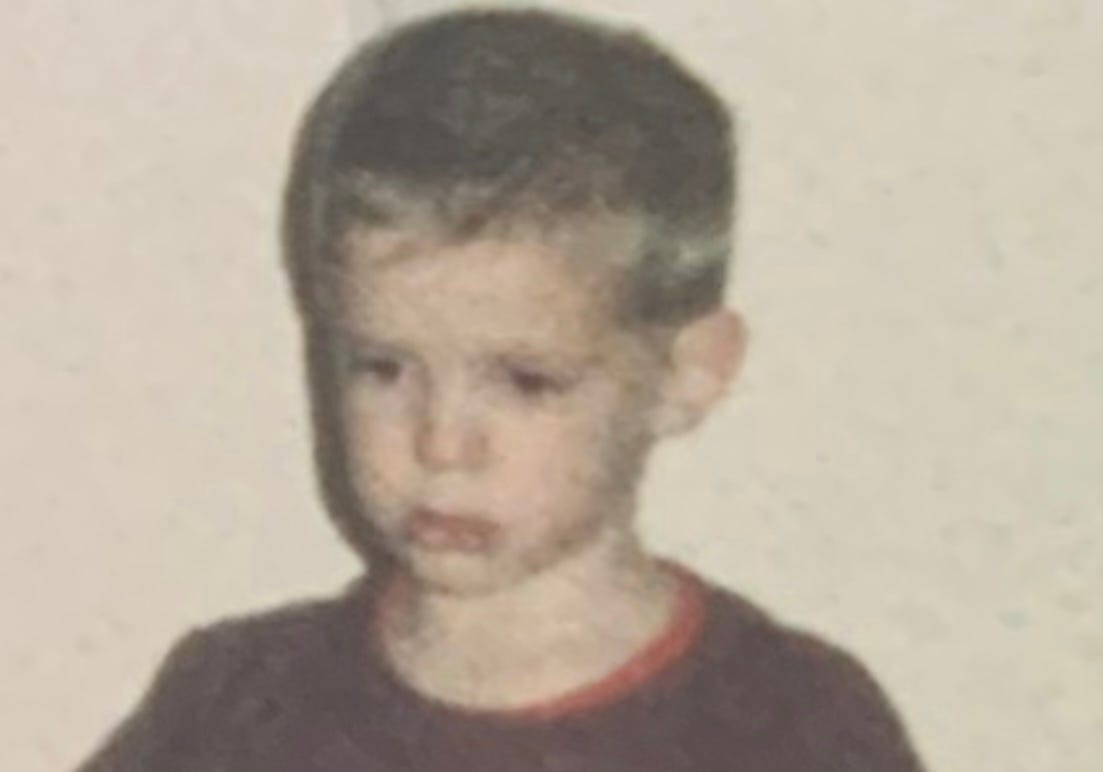
The author in happier times. Photo courtesy of someone who should have made a phone call.
Caveat
We all get sad. Even Joel Osteen.
.jpg)
It is also true that there are gradations of sadness, dependent on numerous factors, not least of which sit at the base of the Maslow’s Hierarchy of Needs:
Psychological
Air, water, food, shelter, sleep, clothing, reproduction
I am genuinely lucky to have easy access to all of these, save for reproduction, which is lucky for the rest of the world.
Therefore, please take the following as a brief attempt to describe parts of one sad person’s experience, even though said sad person — me — has so much going well in his world. I have family and friends I love dearly, and I live in genuine comfort compared to a lot of the world.
Since I can remember, I have described myself as sad. Like my inquiry into OCD and Anxiety, I am trying to partially address what sadness specifically means for me1.
It’s easy to slip into self pity — perhaps that’s how this entire essay comes across to you. If so, I’m not doing what I intended to do, which is to briefly explain what I mean when I say I am sad. When I refer to my sadness.
Alright. Let’s fucking party!
I is Another
When I’m sitting alone at night in my apartment, I stare up at the cement ceilings, amazed at the fact that I live in a place where I can barely hear my neighbors. I let the thoughts fly through my head and pay attention to the emotional or visceral responses I feel in my body. It doesn’t take long before some form of melancholy comes over me. As if my brain does a flip, or a cloud rolls down the center of my mind; sometimes there is a corresponding feeling in my stomach. Either way, it’s an uncomfortable feeling, and if I’m not paying attention, I either don’t notice the pain or sadness I feel, or I notice it and don’t understand where it came from. Within a millisecond, if I don’t examine it, that feeling passes, but it leaves behind a residue that coats my nerves.
When I do notice the feeling, I try to take a few steps back and understand what was the thought that prompted it. I often find it is when I am thinking of the past, and less often, when I think of the future.
Which is to say: When I am not in the present moment.
The past is a mystical land, about which countless words have been spilled, and yet our brains — at least my brain — seem mired there, as if to revisit what happened before will somehow change something that no longer exists. And then, if you remember that those times no longer exist, that the joy you’re remembering will never be again, it ends up being enough to really damper a nice bed sitting session.
I feel the emotion go through me, turn over in my head and my stomach, and then the feeling passes, leaving me to want to understand more of what goes on inside me. So I dive back into that pain, and as said above, I realize that this often has to do with when I am remembering.
After I isolate what thought might have sparked that particular emotional reaction, I then try to understand how I can either accept a thought like that in the future, or how I can avoid that subject. The latter is clearly the more unhealthy, while the former brings about an inquiry that takes me out of the present moment.
For better or worse, I feel this is what brains are made for: to be curious, to find the secret passages, to understand what thought leads to what feeling. It’s an all consuming project, and hard to focus on except in the most quiet of moments.
Does this mean the examined life is really just a life rerun over and over, a constant movie playing, a screen beckoning you to reach out and tinker with the movement in front of you? But the examined life remains just out of reach.
You watch and wish and come away empty.
I find these moments of inquiry to be beneficial in this way: If I am aware of my thoughts and my emotions, perhaps I can somehow fix all of what I feel is wrong with me. All in hopes to not only change what is wrong, but also to forestall its reemergence in the most intimate moments of my life.
Is the answer to accept the pain that comes with awareness? There’s a price for everything, and the price for awareness seems to be a hypervigilance that further complicates everyday movements.
Often these sad feelings will rise up and try to destroy me. They will start in my mind, land in my stomach while passing my heart, tearing at me all along the way. I tell myself I want to be better, and then I tell myself I’ll never be better. Real Catch-22 over here.
To try to explain something as universal as sadness strikes me as just a tad hubristic. But I think it’s important to explain how I feel at my core. And under all of it — the anxiety, the anger, even the happiness — is a deep sadness.
But what do I mean by sadness? It is circumstantial in its way, and there are countless things to be sad about. For example, someone gave Mike Johnson power. That’s plenty sad.
But let’s narrow the aperture a bit. Like Dylan in ‘64, I’m more interested in looking inward. To me, sadness is a third helix in my DNA. When people tell me I need to change the story in my mind, I want to respond with a query on how I can change such a core part of me. Which isn’t to say I don’t feel happy, of course I do; I suppose what I’m saying is that I cannot simply will happiness as a new sheath around the nerves that are on fire inside of me. Rimbaud said, I is another, and perhaps that can be seen as a separation from the subjective pain of life, a way to set ourselves outside of the reach of our true natures. But who knows, he stopped writing poetry at 20, died at 37, and I am cruising into my mid 40s still alive, ever wrestling with I.
This argument that sadness is a choice only goes so far. Yes, we can change our perspective, and we can attend to our emotions, sometimes by letting them alone altogether, but when the root of a person is sadness, it’s not as simple as changing thought patterns.
Is remaining sad just an inability to lie to oneself in the toughest of times? White lies exist for a reason. I’d be lying2 if I said I hadn’t told a white lie in my life, and most of the time, I feel it was because the small kernal of truth was not needed for either myself or another to move forward.
And what do the words of others have to do with my own sadness? It’s a popular thing to say that someone made you feel this way or that, when in truth, as annoying as it is, we ourselves, or at least our natures, choose the way we feel. I need affirmation as a person, and I sometimes wonder if I’m on the extreme edge of that spectrum. What a strange thing to wonder about. All I can do is do my best to be content and stop comparing myself to others. Then again, maybe that’s not going to work at all. What will work is self love3.
Sadness reiterates to me that my body is a large empty cave, with nerves as stalagmites and stalactites, and the wide open spaces of loss and grief spread inside me like interlocking webs.
We humans have studied the brain, and yet we still know so little about it. I suppose if I wanted to, I could delve into my neural pathways and say how this neuron hit this receptor, and when that neuron misses, or misfires, I feel something different, something like October of the soul, something that informs far too much of my day to day life. But to my immense detriment, emotions have always made more sense to me than evidence, and therefore I don’t delve too deeply in the step by step nature of the brain.
I’m often afraid that I am going to slip into a deep, lasting sadness again. I worry that any progress I feel I have made with my anxiety and sadness will be wiped out the moment the smallest push back comes from life. Usually this comes in small little knives to my confidence, or as the ultimate leviathan, heartbreak.
The missing pieces of me have names. They are real and breathing, absolute pillars of life’s joy and purpose and now, gone. Gone, gone, gone. As if they evaporated, were never a solid, only particles in the air, except these memories. These memories are true like ice, like fire.
Memory
I’m tired of my memory. It’s perhaps both my greatest gift and my greatest tormentor. I don’t remember everything, forgetting such simple things of what pills I took, but the pain, loss, regret, and shame I remember all too well. It is as much a part of me as this sinew and marrow, only it does not seem to deteriorate, to race towards the end of life the way the physical parts of me do every second of every day.
And if you look over at me in day to day life, you’ll see a normal enough balding man. Mouth partially open, eyes large, brown, and sad, but what you will not see is my memory’s machine of sorrow.
Maybe you’ll see me laughing, or attempting to make a dead pan joke. How long will the truth and veil of humor keep this sorrow from bursting forth from me, as it has in the past, in the form of misdirected anger and callousness. I turn to humor, again and again, because it makes more sense to me than sadness; but humor has no breath without sadness. It is an almost lifeless thing.
My memory will kill me4.
I’ve come to realize that sadness and memory are something like synonyms. And that the filing cabinet of memory is a bazar of regret, yearning, and brief, ephemeral blanketed sweetness burned away by the grinding nature of time and obligation.
I feel sad when I remember the hope and possibility of since severed connections. The strength and rush of connection are intoxicating, and when they wash over me, I also experience a deep, burrowing fear that what grows in me, what I share with another, will be taken from me, but not if I suffocate it with my fear first.
It is sad to be able to telegraph your mistakes. To look back on your writing and see the same struggles repeated over and over again, every time with a naive determination that the next time will be different, that I will take what I have learned from my past mistakes and finally submit to the beautiful story my life could be.
What’s truly sad is what I most fear: This Sisyphean life will continue, pushing that rock up the hill of life, stumbling and falling on the same shortcomings I seem to be aware of, but cannot solve, causing me to tumble back to the bottom.
Only to start again.
Call it my Holy Trinity of Stability.
About lying, which is like super duper lying, I guess.
Apparently
Death strikes me as bad for my health. But the knowledge of death can also be a synonym for vitality, or focus, or life itself.
My own death does not make me sad, per se; but the death of those closest to me, these ticking time bombs of mortality that move forward in the back of my mind, are waiting to destroy me. I sit here and write about sadness with the full knowledge that perhaps I’ve never really experienced true sadness. But then again, there I am removing myself from the moment again. So maybe that’s against the whole point.